Owner-safe projections
Owner views are designed to remove internal notes, vendor cost/markup posture, raw storage details, and sensitive security context before information becomes owner-facing.

Trust center
Private property operations need more than a login screen. Quoalis is designed around privacy boundaries, owner-safe views, assignment-scoped vendors, reviewed evidence, and human authority. This page answers the questions owners, operators, vendors, and procurement reviewers ask before rollout.
Trust at a glance
Owner views are designed to remove internal notes, vendor cost/markup posture, raw storage details, and sensitive security context before information becomes owner-facing.
Vendor work is packaged around explicit assignments. The product story avoids broad vendor property access as the default operating model.
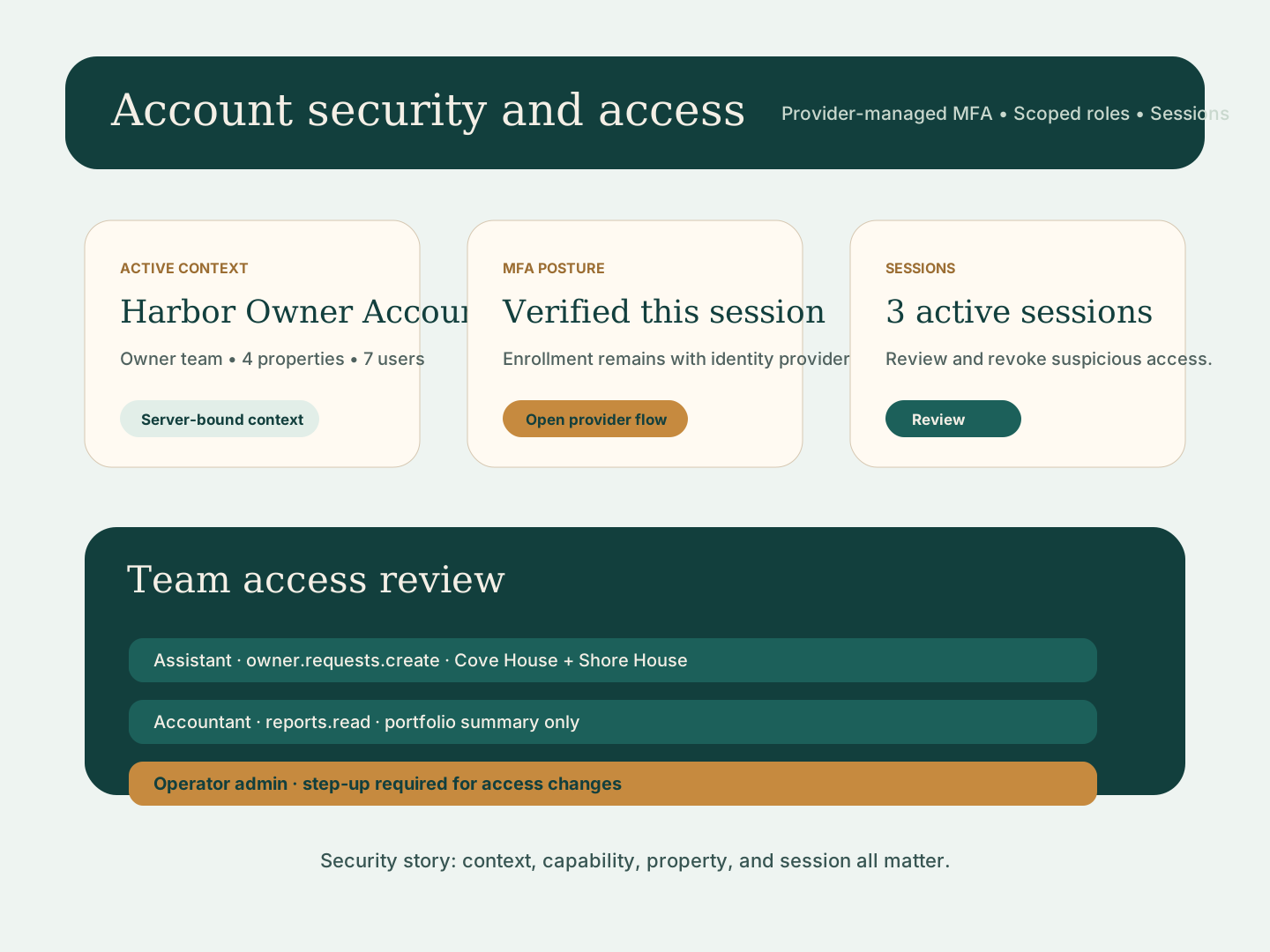
Quoalis delegates sign-in, MFA, recovery, and step-up access to the configured identity provider. The marketing site does not collect passwords.
Media and closeout records are treated as operational evidence. Sensitive evidence should be scanned, reviewed, and intentionally published rather than casually attached.
Procurement questions
Invited production users authenticate through the configured portal and identity provider.
MFA, recovery, session posture, and step-up checks are managed through the identity provider and reviewed during setup.
Owner-safe views are intentionally different from operator, vendor, field, and account-admin views.
No. Public requests start a guided review; production access is invitation-only.
Access codes, payment details, alarm context, raw credentials, and private guest data should not be entered into public forms.
The team reviews roles, data boundaries, integrations, support path, and first workflow scope before production setup.
Data boundaries
Sees: Decision context, approved evidence, next steps
Excludes: Internal notes, vendor markup, operational chatter
Sees: Work queue, triage, assignments, review state
Excludes: Credential secrets or bypasses around policy
Sees: Scoped package, schedule, requirements, upload path
Excludes: Owner contact details or unrelated property history
Sees: Assigned tasks, checklists, bounded capture
Excludes: Broad account or portfolio administration
Sees: Invites, roles, sessions, account posture
Excludes: Unreviewed production access grants from public requests
Reports, decisions, owner-safe timelines, reviewed evidence
Internal staff notes, vendor markup, raw security/access data
Package scope, schedule, messages, assigned evidence upload
Owner contact details, unrelated property history, internal costs
Assigned tasks, checklists, bounded evidence capture
Broad account administration, unassigned property records
Operational command center shaped by capability and context
Secrets, raw credentials, or bypasses around account authority
Visitor route map
Visitors can self-select by role, inspect proof, and move toward demo or access without hunting through the full navigation.
Operating principles
Owner views are designed to remove internal notes, vendor cost/markup posture, raw storage details, and sensitive security context before information becomes owner-facing.
Vendor work is packaged around explicit assignments. The product story avoids broad vendor property access as the default operating model.
Quoalis delegates sign-in, MFA, recovery, and step-up access to the configured identity provider. The marketing site does not collect passwords.
Media and closeout records are treated as operational evidence. Sensitive evidence should be scanned, reviewed, and intentionally published rather than casually attached.
The platform can structure recommendations and workflows, but sensitive actions still route through policy, owner authority, staff review, or step-up controls.
New teams start with a reviewed workflow, support model, security posture, and data boundary map before broader availability claims.
Trust visuals
Provider-managed MFA, session review, invitations, and account context are treated as operating controls.
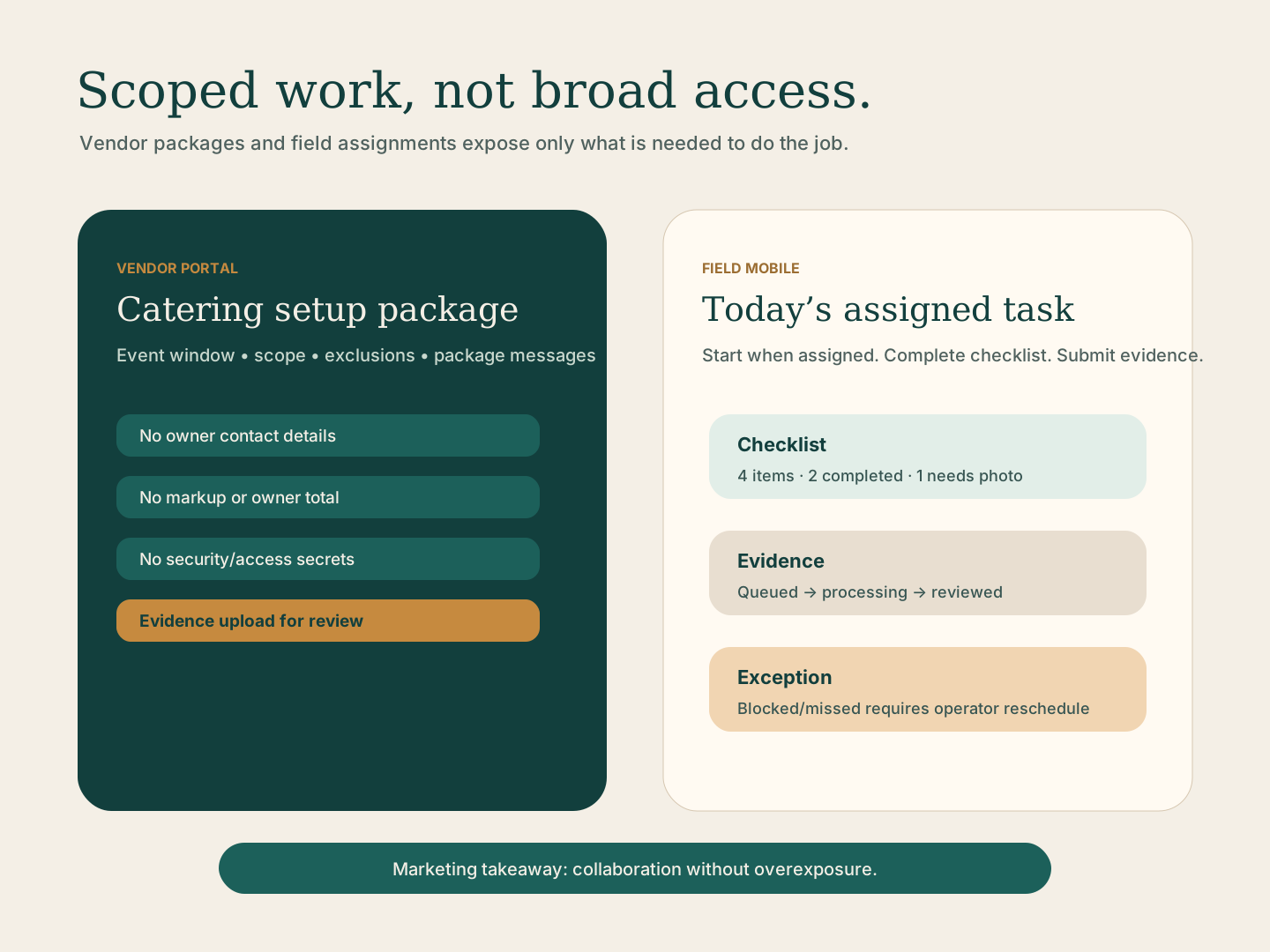
Vendors and field teams get bounded work views instead of broad owner or property records.
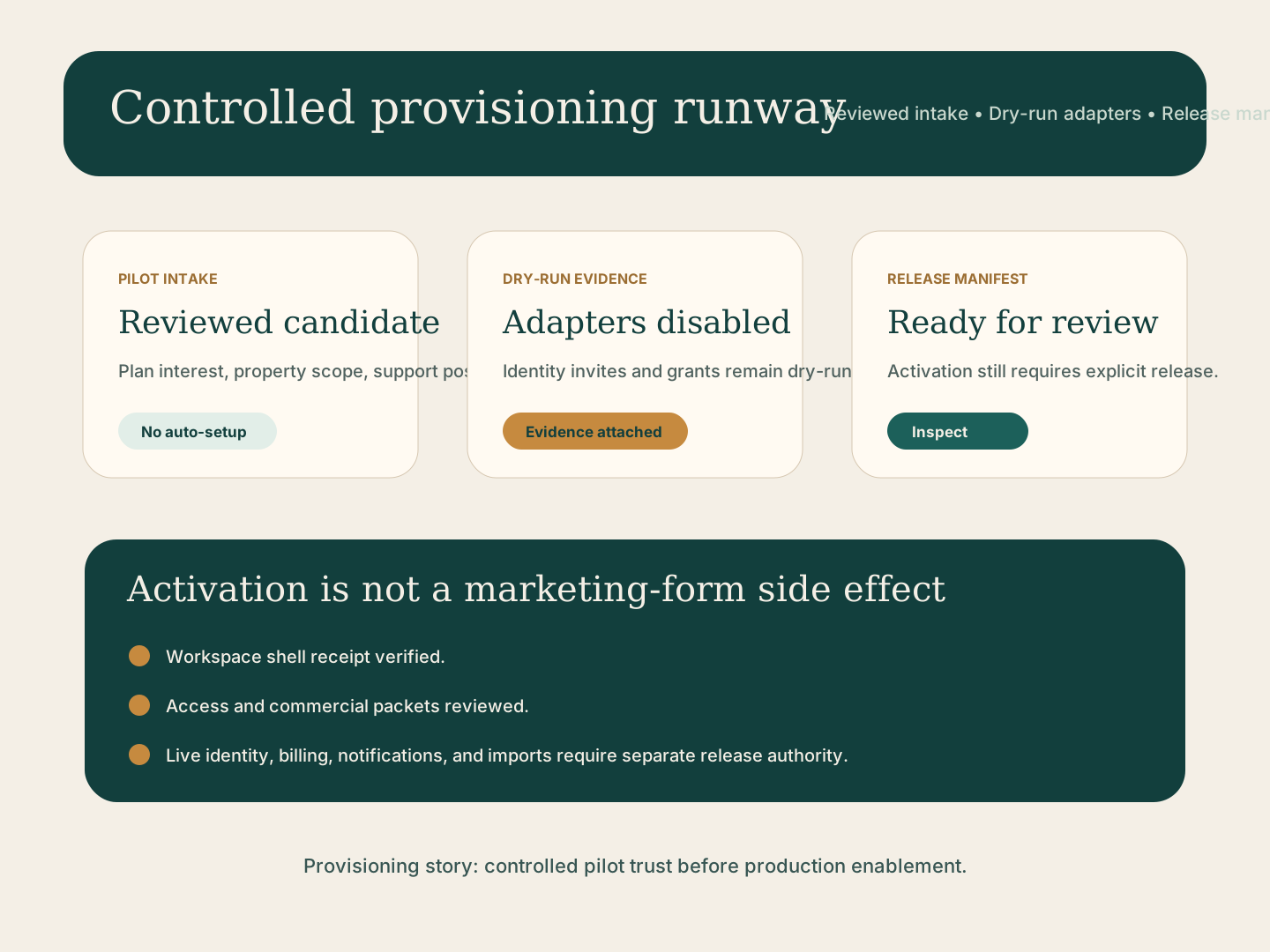
Intake, onboarding evidence, setup checks, and approval records come before production-scale claims.
Access support
Public pages can route the support question, but production identity changes stay inside the configured portal, identity provider, and account-review process.
Confirm the intended role, workspace, and identity provider before a new invitation is sent.
Use the configured provider recovery path; public forms collect only high-level routing context.
Account support reviews authority, property scope, and audit context before access changes.
Vendor users start from package scope and move to production access only after operator review.
Safe to say
Do not claim yet
Claims and proof
Available to review
Proof/source: Owner, operator, vendor, field, account-admin, and evaluator journeys are documented and represented in product boards.
Safe wording: Separate owner, operator, vendor, field, and account-admin front doors.
Avoid: Everyone sees the same dashboard.
Available to review
Proof/source: Vendor and field work board, package-scoped demo path, and trust boundary language.
Safe wording: Vendors work from package-only views.
Avoid: Vendors get property access.
Guided setup
Proof/source: Account security board and provider-managed assurance language.
Safe wording: Provider-managed MFA posture and step-up support.
Avoid: The app stores authenticator secrets.
Discovery
Proof/source: Owner voice architecture and use-case sequence docs.
Safe wording: Future voice-assisted drafting with owner confirmation and staff review.
Avoid: Live autonomous voice commands.
Excluded
Proof/source: Boundary matrix and what-we-do-not-do source language.
Safe wording: The platform structures escalation, evidence, and review workflows.
Avoid: The platform guarantees response, approval, or payment handling.
Buyer objections
No. The platform is designed for private-property operations where owners, operators, vendors, field teams, and account admins need different views of the same work.
Those tools are flexible, but they do not enforce owner-safe views, vendor boundaries, authority, evidence lifecycle, account context, audit, or workflow history.
The intended vendor model is package-scoped: scope, schedule, package messages, terms, and evidence requirements without owner contacts, security detail, internal markup, or unrelated records.
No autonomous dispatch claim should be made. Vendor packages and readiness gates remain controlled, reviewed, and policy-bound.
No. The platform can model closeout, charge candidates, owner decisions, and finance-adjacent evidence, but it does not hold funds or operate as a payment processor.
No. Event/catering workflows can track readiness, required items, approvals, and documentation; they do not provide legal, permit, alcohol, food-service, insurance, or fire-code approval.
What the platform does not do
Quoalis structures private-property operations. It does not replace the people, licenses, policies, emergency services, contracts, or professional judgment required to perform real-world work safely.
Record requests, surface status, support escalation workflows, and preserve evidence.
Guarantee emergency response, dispatch first responders, or replace 911/emergency services.
Scope packages, collect quotes, manage package messages, track evidence and closeout.
Perform licensed trade work, automatically verify every license/insurance posture, or replace vendor contracts.
Track closeout evidence, charge candidates, owner decisions, and finance-adjacent records.
Hold client funds, process payments, escrow money, or act as a payment processor.
Track readiness items, required documentation, and review posture.
Provide legal advice, permit approval, food-service approval, insurance coverage, or guaranteed compliance.
Coordinate home-technology/security-related work and record operational context.
Operate as a central alarm station or monitor emergency/security events as a regulated alarm service.
Assist drafting, summarization, intake, and future owner-confirmed requests.
Execute autonomous real-world actions or voice commands without confirmation and review gates.
Capture interest and reviewed access requests.
Instantly provision a production tenant from a public form.
Adoption posture
Trust claims should follow configured identity providers, support posture, backup/restore practice, and security review. The stronger buyer story is practical: show the workflow, explain the boundaries, and grant access only after reviewed scope.
Request access